About
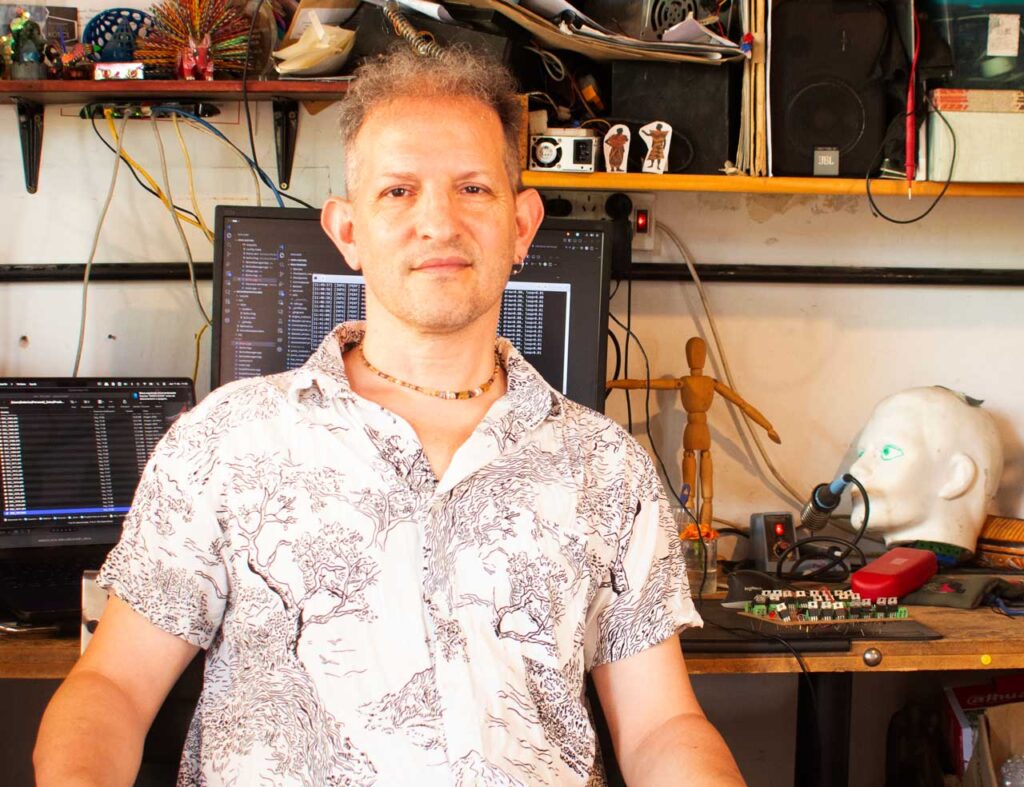
Federico Joselevich Puiggrós is an Argentine technological artist, programmer, lecturer and researcher. His work is constructed through the relationships between electronic art, interactive systems, artificial intelligence, creative coding, the body, sound and technologies applied to culture.
Practice
Originally trained in programming, he works with code not only as a tool for making an artwork function, but as part of what constitutes the work itself. Code makes it possible to construct behaviours, establish relationships, produce environments and give a certain degree of autonomy to machines and artificial organisms.
From this emerge interactive installations, generative systems, robotic devices, stage works, physical interfaces and digital platforms. Across these different forms, his work explores perception, memory, autonomy and the relationships that arise between bodies, machines and environments.
Background
He has worked both individually and collectively. He co-founded and was a member of area3, an art and technology collective with which he participated in developments for institutions such as the Museum of Contemporary Art of Barcelona and in projects connected to the MIT-IaaC Media House Project.
His relationship with programming has also extended into the construction of cultural platforms. He currently leads the technical development of IIIIL.ai, a platform and community for artists working with artificial intelligence, where questions of publication, archives, circulation and the production of digital work converge.
His works, developments and collaborations have been presented in contexts such as Ars Electronica, the Venice Biennale, Sónar, ArtFutura, OFFF, Onedotzero, La Noche de los Museos and different cultural, scientific and university spaces.
Selected works and projects
His works include Los Aparatos, developed with Julia Vallejo Puszkin, an ecology of devices that act autonomously; Los sonidos de la empatía / El Hidrórgano, an installation-instrument constructed through water and sound; R-Lar, which displaces some of the relationships between screen, self-image and communication onto the body of an android; Microbioespecularis, where artificial organisms transform in relation to the behaviour of the audience; and Colorario, which uses an artificial intelligence system to transform the voice into a chromatic triad.
He also coordinated La Máquina del Tiempo, an institutional project developed for the Centro Cultural de la Ciencia through the Faculty of Arts of the Universidad Nacional de La Plata, together with a team of students and former students.
Recognition
His work has received, among other distinctions, the First Prize of the Latin American Kosice Biennial, the MediaLab Award from the Centro Cultural de España in Buenos Aires, the EcoArteUrbano Award, distinctions from Premios Teatro del Mundo and recognition from ATINA. In 2025, Microbioespecularis also received the Exhibition Award of the Fondo Nacional de las Artes Art and Technology Competition.
Teaching and research
Alongside his artistic practice, he has an extensive academic activity. He teaches at the Universidad Nacional de Quilmes and the Universidad Nacional de La Plata, working on electronic art, interactive systems and the production of artworks through digital technologies.
He directs research and development projects in art and technology and is pursuing a PhD in Science and Technology at the Universidad Nacional de Quilmes. His current research examines artificial intelligence and predictive systems in relation to the body, movement and performative arts.
This experience also extends to consulting and development projects for artists, cultural institutions, educational teams and research groups.